
At On Track Wisbech, our curriculum is shaped around the individual needs of each young person. We combine academic learning with practical experiences and personalised support, enabling students to make meaningful progress at their own pace. Our dedicated staff team use their expertise to create a calm, structured and nurturing environment where pupils can achieve, grow in confidence and develop the skills they need for future success.
Admissions
Choosing a school that can meet your child’s needs is an important step, and we aim to make the admissions process as straightforward and supportive as possible. Most placements at On Track Wisbech are arranged through the local authority, and children with an Education, Health and Care Plan (EHCP) can be considered following a request made to the SEND team.
We welcome new pupils at different points in the year, allowing transitions to be planned carefully and at a pace that suits each young person. When a referral is received, families are invited to visit the school, meet the staff and get a sense of our calm, structured environment. This gives parents, carers and pupils the opportunity to see how we work and to decide whether our provision is the right fit for their needs.
For more information, visit our Admissions & Referrals website page.
Curriculum
On Track Education Wisbech is an independent school that supports pupils with a range of complex needs, including:
- Attention-deficit hyperactivity disorder (ADHD)
- Autism
- Behavioural needs
- Social, emotional and mental health (SEMH) needs
Our curriculum aims to equip every pupil with the skills, knowledge and strategies they need to become confident, motivated and successful learners. We want our students to grow into resilient, well-rounded individuals who can contribute positively to their communities and lead fulfilling futures. The Thrive Approach underpins our practice, shaping both our classroom provision and wider support.
Our Curriculum:
- Meets the needs of children with a wide range of aptitudes and abilities.
- Is broad and balanced.
- Includes an emphasis on Life Skills and Basic Skills and Emotional literacy.
- Includes methods and approaches that meet the needs of each individual child.
- Supports the outcomes described in each child’s Education, Health and Care Plan (EHCP).
Our curriculum model aims to:
- Maximise each pupil’s engagement.
- Provide motivating and relevant learning and developmental opportunities.
- Adopt a personalised approach that allows staff to plan in response to a pupil’s individual needs and interests and take into account their barriers to learning.
- Use a combination of Life Skills, Basic Skills and emotional literacy to ensure that pupils are well prepared for the next phase of their journey.
- Lay the foundations for pupils to have a meaningful and independent adult life and are well-placed to make a positive contribution to life beyond school.
- Base learning opportunities on real-life experiences in engaging, cross-curricular, innovative, and stimulating and inspiring ways.
- Promote pupils to engage, participate and try hard.
- Provide children with the foundations for learning so that they can achieve and progress at their own pace.
Curriculum planning should:
- Be highly focused on communication and interaction through a language rich environment and well-planned play, continuous provision and learning activities
- Provide opportunities to generalise skills across a range of contexts.
- Aim to develop our pupils by providing well-planned, trans-disciplinary sessions that maximise engagement, achievement and progress
- Use outdoor learning experiences so that children learn within real world contexts
- Use educational visits or external visitors to motivate and engage learners.
Assessment should be accurate, precise and used to clearly identify:
- Attainment and progress of Life Skills, Basic Skills, emotional literacy and subject specific learning
- Pupils’ stages of development and learning
- Appropriate next steps that allow pupils to access meaningful, appropriate and well-differentiated learning opportunities.
Subject Specific Learning
All subject-specific learning is based on the National Curriculum. Subject-specific learning is important, but we believe that the Life Skills and the Basic Skills that our pupils need to be successful life-long learners are more important. For this reason, we emphasise Life Skills across the whole school day, and Basic Skills are practised in every lesson. Subject-specific learning is targeted in lessons as appropriate to the theme and needs of each child.
Life skills |
Basic skills |
Emotional literacy |
|
Behaviours for Learning: · Engage in learning opportunities and maximise progress and achievement. · Follow basic rules and expectations by using a consistent and positive approach to attitudes and behaviour. · Develop self-esteem and confidence across all areas of learning. · Develop each child’s resilience and thinking skills. To achieve and succeed with a ‘can do’ attitude that reduces barriers to learning. |
Basic Skills are derived from the Unesco report of 2006. These skills are the building blocks for, and underpin, successful future learning. They are transferable and need to be practiced in a range of contexts, environments and situations. All our pupils require many opportunities every day to develop their basic skills in a range of learning opportunities that are appropriate for their needs, abilities and rates of progress. |
Thrive approach: Thrive is a systematic approach to the early identification of emotional developmental need in children and young people, enabling provision to be put in place quickly and responsively. |
|
Communication: · Learn effectively and interact appropriately. · Increase their ability to speak, listen and understand. · Increase their receptive, expressive and pragmatic language skills. Develop appropriate social communication. |
Numeracy: The ability to add, subtract, multiply and divide. More broadly, it means the knowledge and skills required to effectively manage and respond to mathematical demands posed by diverse situations. involving objects, pictures, numbers, symbols, formulas, diagrams, maps, graphs, tables and text. Encompassing the ability to order and sort, count, estimate, compute, measure, and follow a model, it involves responding to information about mathematical ideas that may be represented in a range of ways. |
Communication: Students learn to recognise themselves and their needs. They are coached to use alternative language to express themselves. This enables students to feel empowered and confident to articulate themselves. |
|
Personal independence: · Develop life skills, including self-care and personal organisation, within the scope of their needs and abilities · Understand personal safety and how to stay safe in a range of environments · Access formal and informal learning opportunities as independently as possible. |
Literacy: The ability of an individual to read and write with understanding a simple, short statement related to his/her everyday life. Furthermore, the concept of literacy encompasses multiple skill domains, each conceived on a scale of different mastery levels and serving different purposes. |
Personal independence: Students are given the tools to identify and respond to their own emotions in a controlled and regulated way. |
|
Relationships and social skills: · Develop play skills and effective social communication with peers and adults within the scope of their needs and abilities · Understand the basic foundations of positive relationships, including how to form and maintain friendships Understand appropriate social behaviour. |
Understanding my world/creativity and imagination: · Art · Food Technology · Science · Humanities · Technology / Computing · Dance |
Relationships and social skills: By supporting the children to understand themselves and their own drivers, we provide the building blocks to understand the motivations of others in our surroundings. This enhances their emotional literacy and directly contributes to the development of resilience, resourcefulness, reflective capacity and reciprocity.
|
smsc
At On Track Education Wisbech, we place a strong emphasis on the spiritual, moral, social and cultural (SMSC) development of our pupils. We believe education should support young people as individuals, helping them to build character, confidence and understanding alongside their learning. Through our values-led approach, pupils are encouraged to develop the skills and awareness they need to make positive choices, engage with the wider world and prepare for life beyond school.
Thrive
Thrive is a systematic approach to the early identification of emotional development needs in children and young people so that differentiated provision can be put in place quickly by adults working most closely with the child or young person. It is preventative, reparative, pragmatic and easy to use.
We use it because addressing emotional developmental needs builds resilience and resourcefulness, decreases the risk of mental illness, reinvigorates the learning provision and helps those young people who are at risk of underachieving or exclusion to stay in school and re-engage in learning.
Thrive offers age-appropriate developmental activities which are specifically chosen for individual children. This knowledge is then used to shape our approach and best support our children to access learning opportunities. The adapted approaches will enhance their emotional and social skills, improve their emotional wellbeing and further develop their emotional literacy.
The Thrive approach allows us to look at the behaviour of the child to gain a more in-depth understanding of what they may be experiencing. We have seen that a consistent use of the Thrive approach has helped improve attitudes to learning, increased school attendance in learners’ emotional and social skills and improved relationships within peer groups.
Click here to read more: https://www.thriveapproach.com/news/on-track-wisbech
our school Dogs
Our school dogs Vinny and Daisy play a valued role in supporting pupil wellbeing, emotional regulation, and engagement with learning.
Both Vinny and Daisy are Lhasapoos and are much-loved members of our school community. They provide calm, non-judgemental support for pupils throughout the school day, offering comfort, companionship, and plenty of smiles.
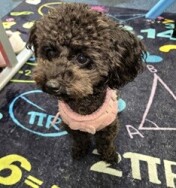 Daisy, our Chief Cuddle Officer and reading buddy, is known for her gentle, patient nature. She has a natural ability to sense when pupils need reassurance, offering a quiet cuddle or a calming presence during lessons. Daisy especially enjoys listening to pupils read, providing a safe and supportive space that helps build confidence and fluency.
 Vinny, our Wellbeing Ambassador, brings a playful yet grounding energy to the school. Highly intuitive and observant, he is excellent at supporting pupils who may feel anxious or overwhelmed. Vinny loves joining reading sessions, curling up beside pupils during lessons, and helping them feel settled and focused.
Both dogs have low-shedding, hypoallergenic coats, making them well suited to our school environment. They support pupils with emotional regulation, sensory needs, and wellbeing, and are an important part of creating the calm, nurturing atmosphere we are proud of at On Track Wisbech.
Vinny and Daisy are truly treasured by pupils and staff alike and make a meaningful difference to daily life in school.
For more information on the benefits Daisy and Vinny bring to our school, please read our School Dogs Statement below:
Post-16 Transition: The HERA Programme
Our Year 11 students take part in the HERA Programme (Health, Education, Responsibility & Achievement), which is designed to support a smooth and confident transition into post-16 education, training or employment.
Through HERA, each student receives individualised guidance to help them understand their next steps, explore future options and build the skills they need for adulthood. The programme includes:
- Personalised PSHE and wellbeing sessions tailored to each student's needs
- Travel training, including using public transport safely and independently
- Visits to local colleges and providers to help students make informed choices
- Practical life-skills, such as managing personal finances
- Support with applications, interviews and transition planning
HERA ensures that every young person leaves On Track with a clear pathway, greater independence and the confidence to take their next steps in the ever-changing world around them.